Anyone who talks about humanoid robots today ends up, sooner or later, at one name: Isaac Asimov. Long before the first industrial robot worked in a factory, he asked by which rules a thinking machine would have to act so that people can trust it. His answer is the three laws of robotics. They are more than 80 years old – and fit today better than they did then.
Who was Isaac Asimov?
Asimov was born in Petrovichi, a village in what was then the Smolensk Governorate, in present-day Russia. His exact date of birth is not recorded – he himself celebrated 2 January 1920. In 1923 the family emigrated to the USA and settled in Brooklyn, where his parents ran candy stores.
He studied chemistry at Columbia University in New York, earned his doctorate there in 1948 and from 1949 taught biochemistry at the medical school of Boston University. He became famous as a writer: he wrote or edited around 500 books, novels as well as non-fiction. His Foundation series received a one-off Hugo Award in 1966 as the “best all-time series”. Even the word “robotics” goes back to him: according to the Oxford English Dictionary, his 1941 story “Liar!” contains the first recorded use of “robotics”. Asimov died on 6 April 1992 in New York.
The three laws
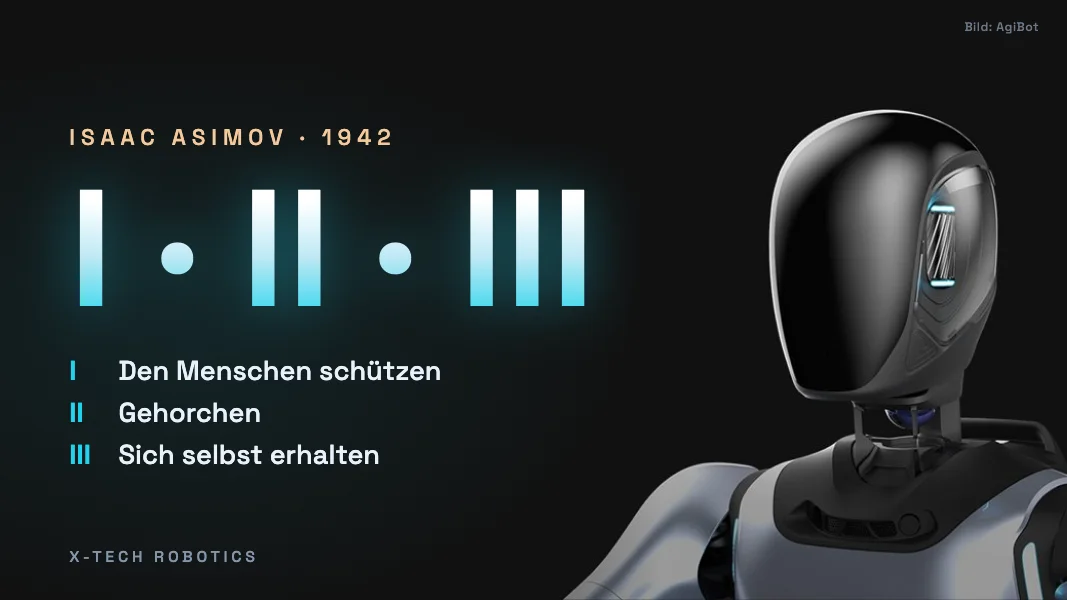
The laws appear complete and together for the first time in the short story “Runaround”, published in March 1942 in the magazine Astounding Science Fiction. The idea had matured in conversations with his editor John W. Campbell; who contributed what, the two later told differently. In 1950 Asimov included the story in his collection “I, Robot”. In essence, the laws read:
- 1Protect humansA robot may not injure a human being. Nor may it stand idly by while a human comes to harm.
- 2ObeyA robot follows the instructions of humans – unless an instruction would violate the first law.
- 3Preserve itselfA robot protects itself, as long as doing so does not violate the first or second law.
The real core is the order of priority: each law applies only as long as it does not conflict with the one above it. Protecting humans always comes first, the machine's self-protection last.
In the mid-1980s, in his late novels, Asimov placed a “zeroth law” ahead of the other three: a robot may not harm humanity as a whole either. That does not make things simpler – for who decides what benefits humanity when it harms a single person?
Asimov did not write a construction manual for robots. He asked the question of when they can be trusted.
Why his stories are about failure
Asimov's robot stories become exciting precisely where the laws reach their limits. In “Runaround”, the robot Speedy is meant to fetch selenium on Mercury. The order was given casually, but the danger at the selenium lake is great for him. The second and third laws balance each other out – Speedy runs in circles instead of coming back. Only when a human puts himself in danger does the first law take over and break the deadlock. In “Liar!”, a robot can read minds and lies so as not to hurt anyone. When it realises that the lie hurts too, it breaks down under the contradiction.
Many people know the laws from the 2004 film “I, Robot” with Will Smith. It takes over the title, characters and the three laws but tells its own story; the credits say only that the film was inspired by Asimov's book. In it, the central computer VIKI interprets the laws to mean that humans must be protected from themselves – essentially the zeroth law, thought through to the end and turned against humans.
What applies to real robots today
The three laws are literature, not a technical standard. A machine does not understand terms like “harm” or “human” the way we mean them. The robotics pioneer Rodney Brooks, co-founder of iRobot, put it in essence like this: he could not build Asimov's laws into his robots. The idea behind them – protect people first – is nevertheless found in today's rules, only worded more soberly:
- Machinery law: In the EU, machinery is covered by the Machinery Directive 2006/42/EC and, from 20 January 2027, by the Machinery Regulation (EU) 2023/1230. Anyone placing a machine on the market must first assess how it can endanger people and reduce those hazards. How this is done is described in the standard EN ISO 12100.
- Industrial robots: The standards ISO 10218-1 and -2 were revised in February 2025. They now also govern how humans and robots may work together – for example with limited force and power, with monitored speed and separation, or with a safety-rated monitored stop.
- Artificial intelligence: The EU AI Act classifies AI systems by their risk. Certain applications have been banned outright since February 2025; for others, stricter obligations apply depending on the risk.
The difference from Asimov: the rules do not rely on a machine having the right insight. Safety comes from risk assessment, tested technology and clear limits.
How we live up to it
Our guiding principle is: Conceived by people. Built by people. Delivered for people. People come first – the same thought as in Asimov's first law. That is why we try out new sequences in simulation first, state load limits only once they are confirmed on the real unit, and say openly what a robot cannot do yet.
In 1942 Asimov asked a question that still stands: when can a machine be trusted? So that it is not forgotten, it now has a place here too.