
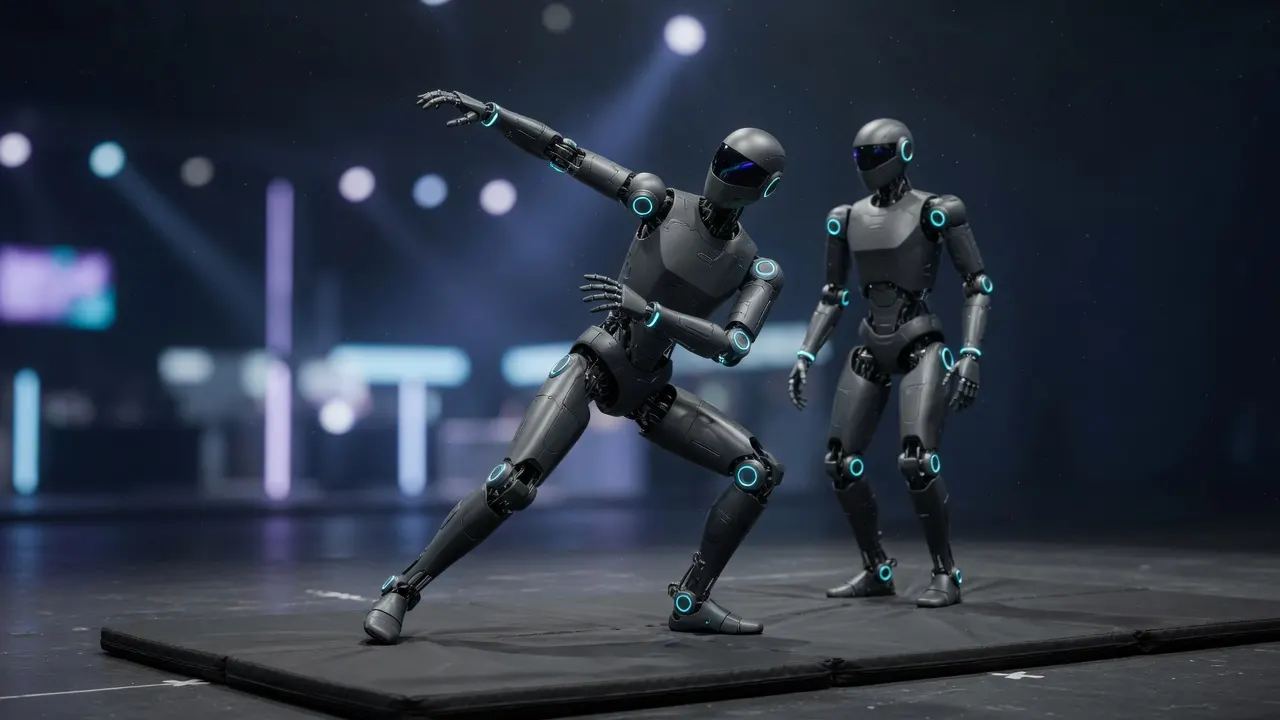
The new humanoid broke a leg in Hangzhou after a failed flip. A few days later, Unitree presented its first quarterly report since going public, with almost 70 percent more revenue and lower profit.
Unitree presented the humanoid H2-X on 21 October. It is intended for security patrols and rescue missions. According to Unitree, the battery lasts up to around 8 hours, compared with 3 hours for the predecessor H2. In the promotional video, the robot kicks in a car door and jumps from a platform about 4 metres high with a backflip. Unitree does not say whether the scenes were autonomous, remote-controlled or rehearsed.
One day later, on 22 October, an H2-X fell at the World Physical AI Conference in Hangzhou. After a failed side flip it tipped over onto the mat, and the right lower leg came off at the joint. According to TechNode and Global Times, Unitree has not given any explanation of the cause. On 23 October the share closed 20 percent higher at 624 yuan.
Unitree CEO Wang Xingxing said at the conference that the real hurdle is the step from demonstration to real-world use. He expects the breakthrough in physical AI in one to two, perhaps two to three years. Kevin Kron of Boston Dynamics had already told VDI nachrichten earlier that real progress shows in uncut footage at 1:1 speed.
On 28 October, Unitree presented its first quarterly report since its listing on Shanghai's STAR Market in August. In the third quarter, revenue rose by 69.93 percent to 665.04 million yuan. Net profit, however, fell by 17.37 percent to 112.69 million yuan, while analysts had expected 224 million according to Reuters. Spending on research and development more than tripled to 127 million yuan, mainly for its own AI models and computing power, according to Unitree.
After nine months, revenue stands at 1.817 billion yuan, an increase of 55.71 percent. The figures have not been audited.