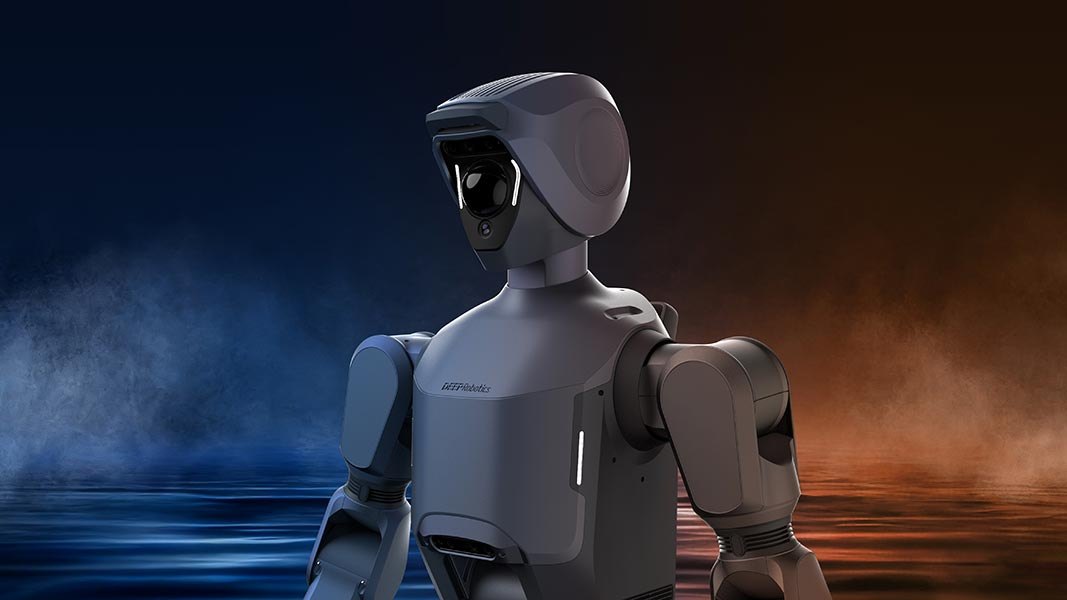
Before a DR02 picks something up at a customer's site, the grasp should already have worked many hundreds of times – in simulation. We train and test grasping movements in NVIDIA Isaac Sim first. Only when a grasp works reliably there across many variants is it a candidate for the real robot.
Why simulation first
Practising a grasp on the real unit costs time, battery charges and, if things go wrong, damaged goods. In simulation the same grasp can be repeated as often as you like – with changed starting positions, different loads and various container sizes, without wear and without the risk of a fall.
What works stably in simulation is the basis for what we later check on the real unit.
The goal: no fixed grasp point
In practice, containers of different makes and sizes stand side by side. A hard-coded, fixed grasp point would already be wrong for the next container. Our goal is therefore for the robot to find the grasp point itself through its cameras – and to refuse a grasp if it cannot find one with confidence.
That is why in simulation we never measure on a single specimen, but on a whole family of containers with different dimensions and loads. That takes more effort than a rigidly programmed grasp, but it holds up in everyday use, when not every container looks the same.
What we do not (yet) claim
Everything described here takes place in simulation. The DR02 has not yet been delivered and is not in operation at any customer. We will publish success rates and load limits only once they are confirmed on the real unit – simulation values alone would be too optimistic.
What comes next
Next up is the transfer to the real unit (sim-to-real). We will report here as soon as there is something concrete to show.